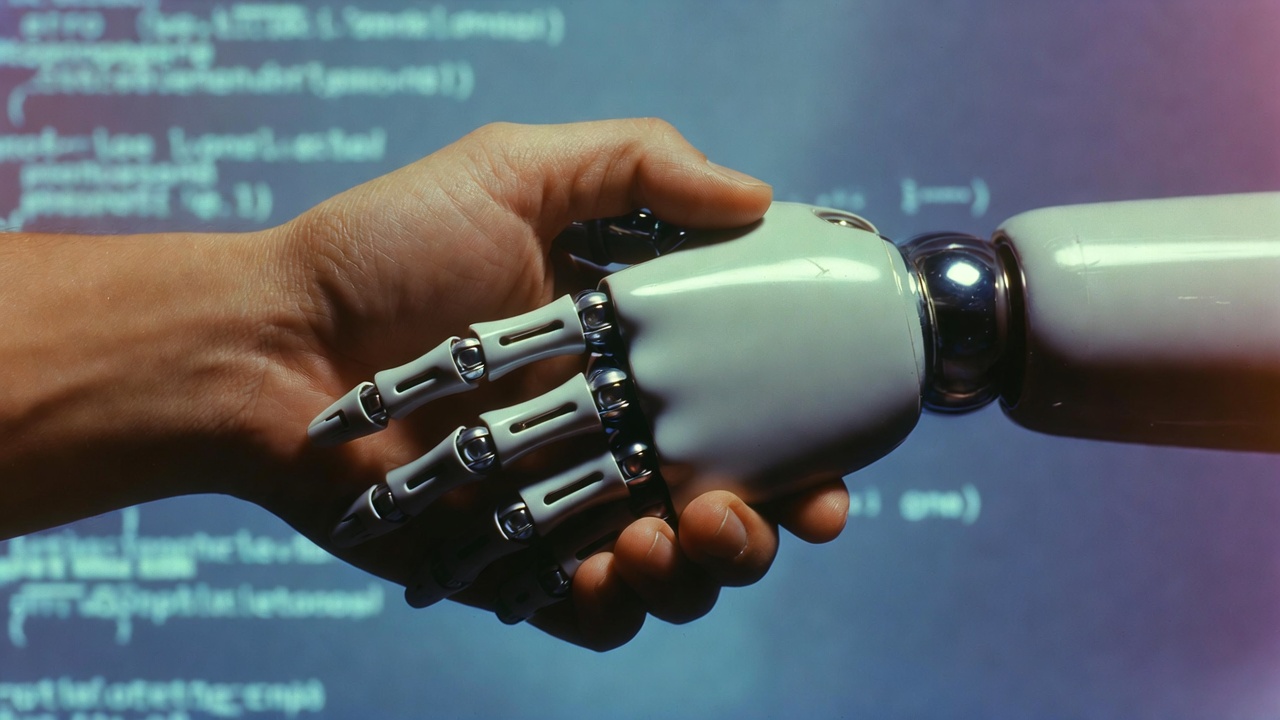
Software Engineering is changing, so is the whole world
How Artificial Intelligence is reshaping an industry that was tasked with building it and the exponential ramification across all industries

David Linhares
Mar 12, 2026 ・ 12 min read
It is not new that Artificial Intelligence is a novel technology that is rapidly increasing in adoption and its applications to real world problems. Many industries have been impacted by the productivity boost of AI assisted workflows. In more recent developments, specially after the release of Claude Opus 4.6 by Anthropic and GPT-5.3-Codex from OpenAI, SaaS (Software as a Service) related products and companies have seen a wave of changes. There’s even a new term for it, the “SaaS-pocalypse”. Although the term makes for a good headline it doesn’t really mean what you would think. Artificial Intelligence is changing Software Engineering as we know it but the indicators are not that the profession is going extinct.
Table of Contents
- If AI is not replacing humans, what is it then?
- A brief history on the computer revolution we are living through
- What do you mean by “computer”?
- Now that we know what “computer” mean, what really are these devices?
- What is work?
- The world is changing, so are we
- Final thoughts
If AI is not replacing humans, what is it then?
The headlines and news of today want you to believe that Artificial Intelligence is replacing humans. The reality is that it is not. Some professions are changing, such as Software Engineering, but professionals are not being replaced by Artificial Intelligence, they are being replaced by other professionals that, using Artificial Intelligence, are now able to control a larger amount of workload.
If anything Artificial Intelligence is not replacing humans. Computers are, and have been for the better part of the last 50 years. Robotics is the future humans are building. As computers get more and more capable, with not only logic problem solving but also physical world problem solving (to the likes we are seeing with Amazon warehouses automations and humanoid robots being tested for repetable tasks such as moving packages around), as time goes on computers are going to become more capable and robots are only going to become more reliable for expanded roles in the industry.
A brief history on the computer revolution we are living through
The world we live in is surrounded by math and math is the real problem humans have been trying to solve. Wherever they go there is a measurable number, be it the distance, be it time, it’s all numbers and everything humans have observed in the planet, and the universe, has been expressed one way or another through mathematical expressions. Physics is likely the branch of science that most impact our daily lives.
Sticking to the topic, everything around us has been translated to numbers and expressions. That’s exactly the reason humans created computers. First it was the numeric systems, then clocks, abacus and other instruments to improve how fast humans could count. Then the calculator showed up and then, “soon” after, personal computers as we know it. Ever since all we are trying to do is math, faster and more complex math. It is also the reason computers are so great doing math.
What do you mean by “computer”?
Lets start with the definition of the word computer. Today when we think of computers the image that comes to mind is a box with a few components inside where we can access the internet, do banking and etc. Computer is defined by Merriam-Webster as “one that computes, specifically a programmable usually electronic device that can store, retrieve and process data”.
The important part for us is understanding what “computing” means. Merriam-Webster also defines “compute” as “to determine especially by mathematical means”, “to determine or calculate by means of a computer”, “to make a calculation” and “to make sense”.
Personal Computers were created as a result of human obsession for mathematics. One of the basis for the computing design of a processor is of an electronic/analog circuit. Analog circuits are represented by circuit diagrams, which uses concepts such as conditionals and loops to translate to real world application of transistors, diodes, capacitors, resistors and etc. All of these concepts are physical world applications of math expressions.
Now that we know what “computer” mean, what really are these devices?
Well, computers are simply purposefully made machines used for storing, retrieving and processing data. No, your personal computer is not the single definition of a computer. Your phone, that is a computer, and a powerful one nowadays. A laptop is usually known as a computer as well. Your car most likely has a computer. Even coffee makers and air-fryers have a computer to some degree (pun intended).
Calculators were fancy computers at the time, they replaced the abacus, which was yet another machine that we created to well count as math became a more complex problem because we, as humans found a more complex problem to solve next we needed to evolve what computers were burst was the calculator and the punchcard and here we are phones that can process as much data as data center in the early 1990s with a network that is such wide and broad that goes all around the world. We have computers in space and we are even looking at building data centers in space - how cool is that?
Computers were here to help us solve one problem, math. Turns out that with some creativity humans can translate many problems to math and have computers solving them. What we are seeing is nothing but one more branch in the development of computers. Now their brains are much more complex and powerful. Machines can connect via network, work in groups, think together, rationallize together, evaluate questions, prompts, you pick, as a unit. And for the most part computers are now more capable than ever and can process a load of data we never imagined, that is, until next year when today’s computers would be outdated and slow in favor of the new faster calculators companies like Nvidia, Apple and AMD are building.
Developments on artificial intelligence are not simply a new technology. It’s an direct and powerful enhancement to computers. What we are doing is not creating a new technology. We are simply improving upon the technology that we already had, computers.
What is work?
There is a philosophical aspect of what to work really means for humans. We humans create identities for ouselves and many times the identity we have is shaped and created based on our lived experience which is, more often than not, impact by our craft. Although the philosofical aspect is important to understand how we perceive the world around us, for the purposes of this article let us focus on the actual definition of work.
Work has many definitions, such as “to perform or carry through a task requiring sustained effort or continuous repeated operations” (reference). It can also be defined as any measurable task that accomplishes goal. That is way too broad. It can mean anything. Even the Earth traveling around the sun is work at that point. If work is a task, measurable in time and effort, then computers have been replacing humans at the workplace since forever.
See, banks are a great example of the computer revolution we are living in. Initially they were impacted with these new fancy terminals that could read databases with some numbers (again numbers and math) with the balances of the customers’ accounts and instantly deduct or add to that number. These terminals were much more efficient than humans keeping track of transactions in books.
So eventually humans were then “replaced” by these smart terminals that could handle banking much more efficient, right? Wrong. You can go to banks today and still work with a human operating a terminal for all your banking needs. Bankers adapted. Sure the number of people working on a given branch of a bank decreased but the number of branches and services a bank could provide increased drastically. Banks have large IT departments and a large number of people are now employed to maintain the infrastructure and technology that power banks. Working in a bank changed but several other lines of profession were created in the process.
It was not artificial intelligence who “replaced” the bankers back then. It was computers. Humans only continue to improve on computers as a technology. We built networks to connect these machines. We created more computers to run tasks in parallel. We created automations to run unsupervised tasks while running tasks in parallel. Computers can reason because they can do more complicated computational tasks which are now targetting one fundamental skill for humans: communication. And the bottom line is, computers can do so much because we want them to.
Networks, chat apps, writing, keyboards, screens, phones, touch sensitive screens. All of these technologies have been created to fit perfectly in how humans are designed so that humans could better communicate. Isn’t it interesting that today not only we can interact with technology with our fingertips but also with voice, which is exactly how humans have been designed?
The revolution we are witnessing has nothing to do with AI ALONE. It has really everything to do with computers and what we want computers to do. Artificial intelligence is just one more development on how computers operate. Computers are the real power asset and tech here. These machines are not just able to solve the problems of logistics because they can measure maps, but they can also solve problems in a variety of fields, as we continue to improve them.
We have algorithms for all sorts of things, and when you take into consideration what an algorithm is, in short a step-by-step instruction on accomplishing a task (remember the definition of work???), computers seem to have been designed for this exact purpose, help humans with their tasks. So what’s really happening is that computers are being developed in a much more efficient way for accomplishing tasks and help humans be more productive.
It’s not that they are replacing humans. They are replacing the task operator. The task becomes an afterthought. A single human is eventually, over a period of time, going increase how much work he/she can do so that less humans are needed for executing a task, freeing more humans to also be productive in other areas of the production chain. That’s exactly a pattern we have been observing in every revolution, be it industrial or digital.
The world is changing, so are we
There was a time where renting a movie would take hours: driving to the store, looking at the movies display, finding a good one to watch, driving back home, watching it a limited timeframe to then drive back to the store and return the movie. Nowadays we can do it from the comfort of our home. Netflix was an impossible concept some years ago, sounds trivial today right? We can do groceries without leaving our home. Impossible thing to even imagine a few years ago.
The only thing computers cannot replace is, well, humans. Computers can automate things we do, but not US. Humanity is moving forward and more than creating problems, we are awesome at solving them. Artificial Intelligence is just yet another creation from our broken hands and creative minds. There’s going to be disruption, professions are going to change and shift over the coming few years. The meaning of work itself might change with the creative automation of tasks that we so dearly work on today but hasn’t that been true in the past?
Many people are scared and anxious on whether or not their occupation is the next to be exposed to AI Risks. In reality, your colleagues are already being more productive by using tools (not exclusive to AI related tools) in order to outperform you at work. The job market place competition hasn’t stop, and it won’t stop. The more tools humnas have at their disposal the more they are going to try and extract the most productivity out of them.
Humans that really understand how to use AI are going to become leaders in this next generation at the workplace, not just in software engineering but across all industries.
Let me preface the transformation in software engineering by saying that AI assisted development is not perfect. This topic deserves its own article. It is actually far from perfect. LLMs have a deep flaws in their architecture, everything is just text for these systems. There’s no meaning, no weight, no attachment to concepts, it is all just text. Predicting the next letter/word is their job. Not reason, autocomplete.
Even with the right context and text right in front of the LLMs, it is going to fail and hallucinate disproportionally. We are not at the point where the text (and code for that matter) produced by these LLMs can be trusted, and companies have started to feel the pain of relying on the unreliable. Amazon recently made news when an internal meeting was held to require, from more senior engineers, signoffs on any AI-assisted mid-level engineers changes. Mind you we are talking mid level engineers, not juniors who are just getting started.
Going back to the transformation in software engineering … Software engineers are the power users of AI related tooling. They also happen to understand the technology better than any other occupation. What started as prompt engineering quickly became context engineering and now the next frontier of what I have been understanding as AI Enhanced Engineering is agentic engineering.
Software engineers are going to start managing teams of AI Agents and in a future not so distant these engineers are going to be leading the industry in not only a fast pace development but also a very dynamic occupation. LLMs still not reliable in code generation but with enough headstart from AI Agents, engineers can spend more time in architecture and core business model improvements while still having agents bootstrap certain work.
AI Agents can quickly escalate from “productivity boost” to “losing control of your own codebase”, *thread carefully.
Engineers with high levels of curiosity have been already experimenting with agents, skills and AI enhanced development for quite some time. They went from “these models are not good” to “these models are starting to show a bit of help with some low grade tasks” to now “this code kind of makes sense although there are flaws and requires work to be production ready”. We are at the point where engineers are getting comfortable with “I can work with that”.
I stress, the technology is not ready for being autonomous and must be throughly supervised by a human engineer. LLMs more often than you think would FABRICATE answers, create false, unreliable, invalid text and still call the job done.
Engineers have also been building all of the infrastructure and software that powers most of today’s business. So if logic has it right, a shift in how engineering teams produce is going to ripple through the industry, impacting each and every one of the business that somehow rely on software, or any digital technology for that matter. Do you write reports for you business? Well, an engineer can learn how to do that and create AI agents that would be able to run all those reports in the background. Maybe you are creating an business to help people find business around your area? Well, you guessed it right, there’s an engineer somewhere that is going to find a way to automate that too.
We are moving towards a future where personal software might be a real thing. A curious, dedicated and creative person might actually become a Tony Stark like figure, directing, brainstorming ideas with its own Jarvis and getting to real outcomes in life.
Hopefully no one ever creates Ultron in the process.
Final thoughts
The only real way to become an irreplaceable person is to become one that is so resilient to change, and that can look ahead, but so much further ahead, that can imagine what the future would be. Here is a thought exercise, what is impossible today that most definitely going to be trivial in 10 years from now and that you want to be a part of?
Leave a comment down below and let’s continue the discussion.
See ya! 👋